Overview
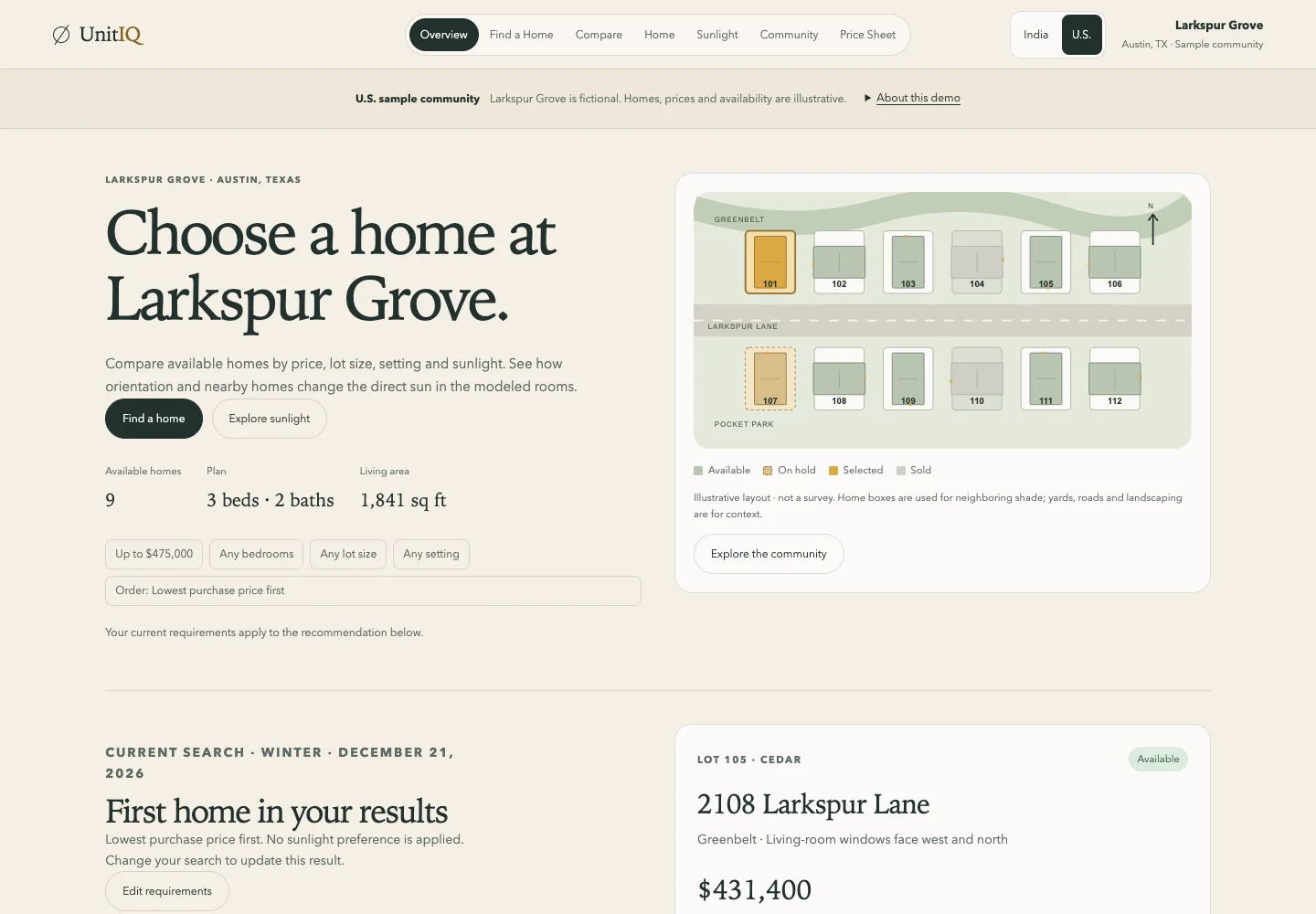
Choosing a residence involves trade-offs across price, layout, orientation, availability, and family preferences. UnitIQ brings those decisions into one journey: set requirements, explore a shortlist, compare three residences, inspect sunlight, review a price sheet, and prepare a selection brief.
I built this as an independent personal project with two fictional demonstrations: Larkspur Grove, a detached-home community in Austin, Texas, and Aurelia Residences, an apartment project in Gurugram, India. The U.S. experience opens by default; each market has its own inventory, commercial rules, terminology, and saved buyer session. The project has no Lennar or other homebuilder affiliation.
From Requirements to a Shortlist
Hard requirements filter inventory before preference ranking. The India journey considers budget, floor, view, and bedrooms; the U.S. adapter uses home and lot requirements with USD purchase-price rules. Up to five matching recommendations expose their trade-offs, and an empty result offers a path to adjust requirements.
Buyers can compare three residences, inspect itemized charges, share the full comparison context with family, and download a selection brief. Validated URL state takes precedence over browser-local state, so shared links restore the intended market and choices. Advisor and reservation forms simulate completion without sending data or reserving inventory.
System Architecture
Next.js and React provide the product shell, TypeScript domain modules calculate the results, Tailwind CSS styles the interface, and Three.js renders the interactive spatial views. The current prototype runs its domain calculations in the browser and is deployed on Vercel. It uses fictional data adapters and browser persistence.
flowchart TD
    A["Fictional market data<br/>inventory, pricing, site and plans"] --> B["Deterministic domain modules"]
    C["Validated buyer session<br/>requirements and preferences"] --> B
    B --> D["Eligible inventory<br/>ranked recommendations and price lines"]
    B --> E["Solar position and window access<br/>shared room and home intervals"]
    D --> F["Shortlist, comparison<br/>residence and price sheet"]
    E --> G["2D plans and Three.js views<br/>room timelines and shadow context"]
    D --> H["Shareable links and printable briefs"]
    E --> H
    C --> H
The shared contract matters more than the rendering technology: a selected residence, reference date, orientation, and model version must produce consistent results in the recommendation, plan, comparison, timeline, and exported brief.
Sunlight as an Explainable Decision Input
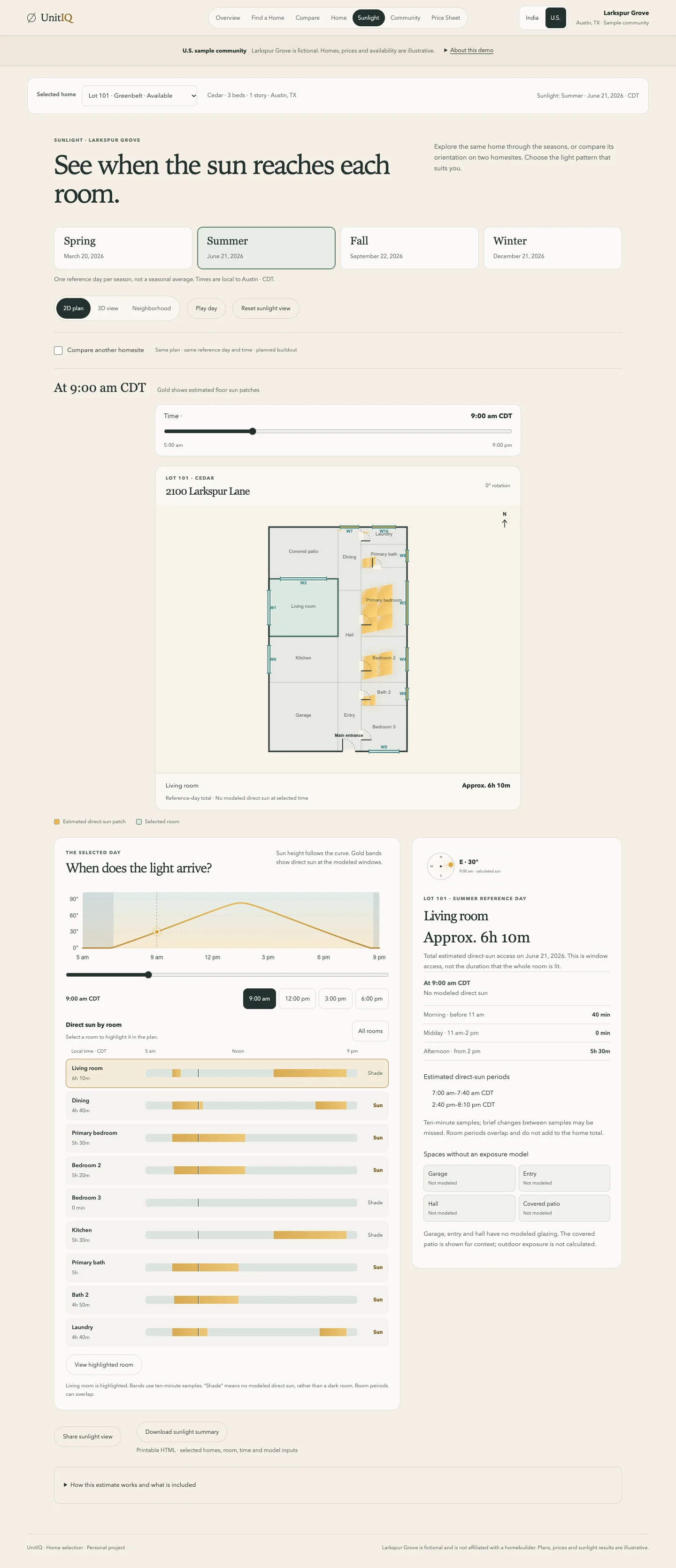
The solar kernel computes the sun's position from site location, reference date, local time, and orientation. Window-access checks account for simplified obstructions. In the U.S. model, positioned window cells are checked against roof, eave, and neighboring-home proxies. Room and home durations use unions of sunny intervals so overlapping windows and rooms do not inflate the total.
Shared results drive animated 2D plans, rotatable 3D views, room time bands, synchronized two-home U.S. studies, and printable summaries. Neighborhood ground shadows show a separate receiving surface from indoor floor patches. Austin's date-aware CST/CDT and India's IST keep the displayed time tied to the modeled site.
Key Engineering Decisions
Keep ranking, pricing, and sunlight deterministic
A buyer should be able to inspect why a residence matches and how a price or duration was calculated. Explicit requirements, visible preference weights, itemized rules, and versioned sunlight models keep those answers reproducible. AI does not generate the numbers. Grounded LLM explanations remain a future extension.
Calculate once and reuse results across the experience
Separate calculations for charts, 3D scenes, recommendations, and exports would drift. Shared geometry and interval results keep each view consistent. The U.S. Cedar schematic and aperture model are versioned independently from India's partial apartment schematic, preserving the meaning of each market's results. A 3D failure leaves 2D and list-based decisions available.
Use explicit adapters and independent buyer sessions
Austin homes and Gurugram apartments differ in requirements, geometry, currencies, commercial rules, and solar context. Each adapter owns those inputs while sharing the core engines and visual components. India offers transparent, versioned Vastu preference scoring; the U.S. experience omits it. Family links identify their market and restore validated choices without carrying contact details.
Avoid declaring a universal sunlight winner
More direct sun is not always the buyer's preference. New U.S. sessions start with no sunlight preference and support choices such as less afternoon sun. Room intervals explain the trade-off without presenting a duration index as a daylight-quality, comfort, or energy rating.
Outcome & Reflection
The result is a working, shareable selection journey that demonstrates product engineering alongside data modeling and consistent visual explanations. Repository validation covers domain calculations, session handling, rendered output, and desktop/mobile browser journeys. The strongest lesson is that a convincing visual needs an inspectable data contract: every screen should explain the same residence and the same calculation.
Inventory, pricing, offers, and geometry are fictional. The U.S. plan is an invented Cedar schematic; India's apartment schematic is partial. Sunlight estimates model simplified direct-sun access and exclude diffuse daylight, weather, glazing performance, reflections, glare, and thermal effects. They are not engineering-certified daylight results.
A real builder pilot would require approved plans and site inputs, physical validation, reviewed versioned contracts, real inventory and pricing integrations, persistent storage, access controls, and an actual CRM handoff. Those remain future work. The live prototype proves the interaction and internal consistency of the demonstration.